Monday, October 11, 2010

Action Plans and Excitement

Hello All!

It was another interesting and productive day on the tundra. We began the day with a teleconference to Herrera Elementary School in El Paso Texas. The kiddos were so curious about all things polar bear, as the polar bear is their school mascot! We then had an intereactive presentaion with Robert Buchanan, president and CEO of Polar Bears International. He inspired and impassioned us to go beyond our roles as educators to become mentors in order to inspire the greatest generation of conservationists yet!

Next we took another afternoon tour on the Tundra Buggy, where we saw our first arctic hare of the trip, and in addition to that we saw 2 color phases of snow geese the blue phase, and the white phase, and a polar bear that roamed very close to ourAct Buggy! Very, very importantly we created an action plan for our Communicator Leadership Camp. We committed ourselves to work in a support capacity with the people who formulated the Acres for the Atmosphere action plan, by annually reducing 25,000 metric tons of carbon emissions (as a group collective amount), in whatever ways we can creatively accomplish this. We feel good about this, because it is all about partnerships, positive action, and saving precious ecosystems, such as the tundra, and all its inhabitants.

In addition to all of that excitement, we learned from other experts who spoke about polar bear/zoo connections, field research, and PBI resources that can be accessed for educators. There is so much to reflect upon and do, and new friends and colleagues to keep in touch with. Tomorrow we head back to town to tour Churchill, then a flight back to Winnipeg in the evening. Endless thanks to all of our hosts, facilitators, presenters and guest speakers who have created this forever memorable experience for us!! Good night friends and bears.

See you soon!

Friday, October 8, 2010

More news from the Tundra

Good morning, everyboby!

Lots going on here in Churchill. Yesterday morning we did a live videoconference with a school in North Carolina--it was lots of fun. We also saw a bear roaming around our Buggy that one of our biologist experts estimated was upward of 1000 pounds. He was massive!

We took off in the Tunda Buggy and got a chance to rove up to a smalll area of boreal forest, where 2 of our botanical experts gave us some wonderful information. For example, in order to offset our average indiviual carbon emissions we would each have to plant 8,000 trees- and that would hold us for 80 years before we would have to plant 8,000 more. There are two species of trees we saw: black spruce and tamarack. They exhibit an appearance called "flagging" where the needles only grow on one side of the tree due to the brutal winds blowing in certain directions. There is a type of lichen called caribou moss, which is very soft to the touch, spongy and absorbent, and the Native Americans used it for baby diapers.

We saw lots of ptarmigans in various stages of mottled and white coloration, transitioning to their winter camouflage. They have very feathery legs and feet and they look so funny when they walk! On our way back to the lodge we saw 2 rainbows and I took those as a sign of good fortune.

We have had guest speakers and we are learing so much. One of the coolest things was that I got a chance to drive the Tundra Buggy for a few minutes!!

Last night I awoke in the middle of the night to a clear sky filled with more stars than I have ever seen, and I sat and watched the Northern Lights. It was such a calm and peaceful time. This morning we saw another bear outside our lodge, right underneath us looking up at us-- WOW !!! Today we have another busy day ahead of us and I must go. My best to all!

Kathleen

Thursday, October 7, 2010

Greetings from Churchill Canada!

Dear friends,

Hello from Churchill Canada!

Lots of exciting happenings here in the land of the polar bears. Have I seen any? YES!! Yesterday on our journey out to the Tundra Buggy Lodge, we saw, get this--polar bears, and arctic fox, a snowy owl, ptarmigans, an immature bald eagle and a short-eared owl! We were so stunned and thrilled when we saw our first few polar bears that we all ran to the windows calling to each other and laughing and snapping away with our cameras that we looked like the polar bear paparazzi, and I know we probably spooked some a bit. We were much more calm today. There is actually a polar bear outside our lodge right now, just a short distance away, taking a snooze. The arctic foxes we have seen have lovely bushy tails, and their white winter coloration, and it is fun to watch them bound lightly through the grasses and kelp trying to flush out birds and things.

The landscape is so unlike the forest surrounding us in Kentucky. There is a good view of the Hudson bay, along with lots of rocks covered with some wild looking orange lichen as well as other colors of lichen, such as black and green. We have been told that the lichen is actually a healthy snack if you scrape it off the rocks and boil it for a couple hours. We have not had to resort to that yet, as we are graciously being fed very well.

To look out in any direction and see no people, buildings, or vehicles is such a novel and strange sensation. I am small to begin with, but believe me I now feel very, very small indeed and it is humbling. At the moment the wind is blowing fiercely, and it is cold and cloudy. I can feel the lodge buggy swaying in the gusts. There may be a bit of snow tonight. At the moment the landscape is not snow or ice covered, but there was some skim ice on pools of water this morning.

It is surprising how well camouflaged the polar bears are in this setting that is not really a stark white. One bear was directly below us in the open air space between the buggy cars yesterday evening, and she or he was beautiful and majestic. Its paws are HUGE! It may be the same one that was back this morning and is lounging out there now.

There is so much to learn about this ecosystem, the animals, plants, people and all the interactions. I am making new friends and colleagues, which is fulfilling on many different levels. Thanks to all who are supporting me in this experience, and thanks to PBI (Polar Bears International) for giving me this wonderful opportunity! I will try to get some pictures sent eventually. See you soon!
Wednesday, June 9, 2010

Cleaning The Pool


Louisville Zoo Glacier Run staff enter the 108,000-gallon Seal and Seal Lion pool for the first time on June 7, 2010, to vacuum and clean it to prepare it for the seals and sea lions. The exhibit is set to have a public Grand Opening on June 30, 2010, at 10:30 a.m.

Tuesday, June 8, 2010

Lightening Strikes

High atop the Glacier Run exhibit stands a tall metallic rod with a unique design. This is the new wave in lighting protection. Because of the risk of a lightning strike and the large amount of water held in the pools, the rod system is actually protection for the exhibit and the animals it will house.

Monday, March 29, 2010

Amphitheater Seating


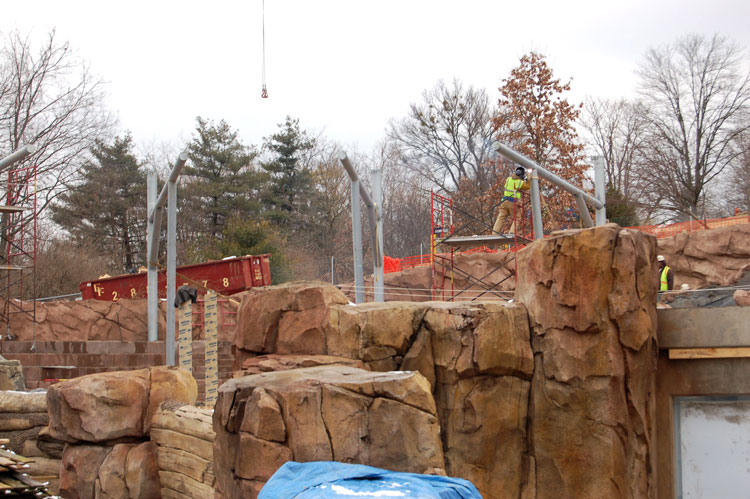
Once the seal and sea lion portion of Glacier Run is complete, there will be shaded seating for 200 plus room for 100 standing to watch seal and sea lion training. Currently, workers are welding amphitheater structure beams that will eventually be painted and decorated with fabric from above.

Tuesday, March 16, 2010

BIG BLUE

If you go past the Glacier Run construction, you will notice large big, blue tanks.

Just in case you were curious, these will be tanks filled with sand that will filter all the salt water that will be used in Glacier Run.

Thursday, February 25, 2010

FAKE OR REAL?

Even in 27 degree weather, the Glacier Run construction team is working hard. One project that is being created is a 26-foot glacier ice wall in the polar bear exhibit portion of Glacier Run.

The detail is spectacular because the glacier actually looks like it is pushing through a rock face and has real icicles. The glacier wall is made up of white concrete. One of the final steps in the process will be adding paint including touches of blue paint to create a true glacier look.

To protect the ongoing work of the glacier wall, plastic is currently draped over scaffolding so it doesn’t get too cold. Since the wall isn’t visible when walking past the construction area, here some sneak peek photos for you!

Remember – the polar bear habitat won’t open until 2011 but the seal and sea lion habitat opens this summer!!

Thursday, February 11, 2010

A Real Backyard Action Hero!

Can one person make a difference?

Nine-year-old Elizabeth Seiler thinks so.

After reading an article about the Zoo’s upcoming Glacier Run exhibit in Zoo’s current Backyard Action Hero Guidebook which focuses on adventures in the Tundra, Elizabeth was inspired to help.

So the Dunn Elementary third-grade student proposed a plan to her principal Margie Eckerle to let the students collect Cents for Seals and Sea Lions and Pennies for Polar Bears.

Principal Eckerle agreed and promised that for every milk carton filled with money, that class would receive one extra minute of recess.

Elizabeth urged her classmates to donate their spare change and in just 10 days they raised $737 for the Zoo’s Glacier Run exhibit!

The Zoo is honored by Elizabeth’s donation and encouraged by the commitment and generosity she and her schoolmates have shown. She is an inspiration to us all.

If this story has motivated and spurred you into wanting to help build Glacier Run, too, please contact the Zoo’s Development Department at (502) 459-2181 to find out how you can help.

Also, be sure to download the Zoo’s Backyard Action Hero Guidebook focusing adventures in the Tundra that inspired Elizabeth at http://www.louisvillezoo.org/BAH/index.htm.

You can also see WAVE 3’s news story and video of Elizabeth at http://www.wave3.com/Global/story.asp?S=11858114.

Wednesday, January 27, 2010

What's 8,000 pounds, 5 inches thick, 13 feet wide, 21 feet tall and Clear?

Glacier Run construction hit a big milestone this week. Make that an 8,000 pound milestone.

An 8,000 pound acrylic window 5-inches thick, 13-feet wide and 21-feet tall (that’s as tall as a two-story building, wider than two full-sized pickup trucks parked side-by-side and as heavy as 15 grand pianos) was installed at the Zoo’s Glacier Run exhibit.

The window, designed to contain 85,000 gallons of water in the polar bear outdoor pool and withstand a full grown 1,000 pound polar bear swimming at full speed, was lifted with a 65-ton crane.

It was one of four large acrylic windows installed this week—one for seal and sea lion viewing and three for polar bear viewing (including the 8,000 pound one).

Local media showed up to cover the installation and talked to Mark Zoeller, Louisville Zoo Assistant Director, and Tom Young, Project Manager with Whittenberg Construction.

Tuesday, December 29, 2009

Welcome to "The Polar Bear Capital of the World"
Part 2

Overview
Recently in October, two Louisville Zoo staff members (Education Curator Marcelle Gianelloni and Public Relations Manager Kara Bussabarger) along with Louisville Zoo teen volunteers Emily Goldstein and Brandie Farkas traveled to Churchill, Manitoba, Canada on an all-expense paid trip courtesy of Polar Bears International. [For more information on how they got to go, check out http://www.louisvillezoo.org/projectpolarbear/award.htm.]

By Kara Bussabarger, Public Relations Manager

You think milk is expensive? One visit to Churchill, Manitoba, Canada, (the “Polar Bear Capital of the World”) and you might think different.

  • A gallon of milk is $8.29 a gallon ($8.75 Canadian).
  • Bread is $5.10 a loaf ($5.39 Canadian).
  • Peaches are $3.12 a pound ($3.30 a pound Canadian).
  • Bananas are $1.63 a pound ($1.72 a pound Canadian).
  • Ice Cream bars (package of 6) is $8.80 ($9.29 Canadian).

The prices likely have something to do with the remoteness of Churchill. It is a town of 800 residents and you can’t drive to get there. There are no actual roads to Churchill, there are only two primary modes of transportation to get there—air and rail. And there is only one grocery store in town. Actually is more like a general store—selling clothing, furniture, toys and food.

We were told most of the residents in Churchill live in government apartments. And since housing is on permafrost (ground that is permanently frozen, but sometimes thaws in the summer) the houses often have to be adjusted underneath with jacks to level them out.

While there, the Zoo group stayed at the Tundra Inn (http://www.tundrainn.com/inn.html), a quaint 31-room inn. Note, there are no luxury hotels in Churchill and there is absolutely NO cell phone reception. There is a computer in the Tundra Inn lobby guests can use to communicate back home, or if you bring your laptop, you could utilize the internet connection inside your room.

If you go to Churchill and are not use to the cold weather, be sure to bring warm clothes. We are talking about wearing two pairs of long under wear, three shirts, scarf, hat and two jackets at one time. If you conjure up the image of the small child off the Christmas Story you are on the right track! The average temperature during October is about 20-30 degrees Fahrenheit with an average of 2 hours of sun a day. (http://en.allmetsat.com/climate/north-america.php?code=71913) While this can be a harsh, unrelenting environment, it is also one of the most stunning, magnificent places in the earth.

For more information on the town of Churchill, you can visit their website at http://www.churchill.ca.

Thursday, December 17, 2009

Welcome To "The Polar Bear Capital of the World"
Part 1

Overview
Recently in October, two Louisville Zoo staff members (Education Curator Marcelle Gianelloni and Public Relations Manager Kara Bussabarger) along with Louisville Zoo teen volunteers Emily Goldstein and Brandie Farkas traveled to Churchill, Manitoba, Canada on an all-expense paid trip courtesy of Polar Bears International. [For more information on how they got to go, check out http://www.louisvillezoo.org/projectpolarbear/award.htm.]

By Kara Bussabarger, Zoo PR Manager
Churchill, Manitoba, Canada, is located on the shores of Hudson Bay, and was given the name “Polar Bear Capital of the World,” because it’s the largest concentration of polar bears in the world at one time. During the peak polar bear season in early October through November, more than 1,000 polar bears congregate around the shores of the Hudson Bay as they wait for the ice to freeze so they can begin their hunting season.

Churchill was once a military base for United States and Canada and is now a small town of about 800 residents. The economy is based on a number of thriving sectors such as mining, transportation, forestry, commercial fishing, trapping and tourism. Prince of Wales Fort, built in the mid 1700s by the Hudson Bay Company, sits just across the river, a solid reminder of the fur trade which first put Churchill on the map.

When you visit Churchill, you should be aware that a polar bear may be encountered anywhere at any time of the year. There are “Polar Bear ALERT” signs posted around town as well as a special polar bear alert phone line (675-BEAR) for sightings. Conservation officers first try to scare off any bears that wander into town, usually with ear-piercing cracker shells although sometimes rubber bullets are used. When that doesn’t work, the bears are trapped using a bear trap (a large metal cylinder baited with seal meat or oil) and are detained in the Polar Bear Compound at the edge of town for up to 30 days or until the ice on the Bay has frozen over. The Compound contains 28 holding areas and bears are isolated from people to avoid a familiarity and dependence on humans. While the Louisville Zoo group was in Churchill, the Compound housed about 16 bears. One was even caught wandering the town while they were there!

Early one morning, Zoo staff members Marcelle Gianelloni and I walked to the post office to mail postcards back home. Later that morning at breakfast, we were told a polar bear had been caught in the street next to the post office—just a few minutes after we had left. It was an almost “too-close encounter!”

Did you know that the Zoo’s upcoming Glacier Run exhibit is loosely modeled after Churchill? Glacier Run is an imaginary mining town located at the edge of the arctic wilderness where Zoo visitors will become immersed and actively involved in the exhibit experience. The seal and sea lion habitat are scheduled to open in 2010 with the polar bear habitat slated to open in 2011.

Monday, December 14, 2009

A Town On The Edge Of The Arctic

Construction has begun on the town of Glacier Run, which is modeled after an imaginary mining town located on the edge of the arctic wilderness. Based on the idea that humankind and nature must co-exist, Glacier Run will be a truly unique experience where you an visit the animals, talk to the keepers about conservation and become temporarily immersed in life on the tundra. The exhibit will recreate the natural habitat for some of the Zoo's most popular residents including polar bears, seals and sea lions.

The town will include a school house and general store. One fun interactive feature will be a parked truck in which visitors can sit while polar bears explore the truck bed behind them (separated by a glass barrier of course). Bears will also walk over visitor's heads along a walkway resembling a mine shaft. (Click on the image above to see a larger view of what this experience will look like.) A spacious amphitheater will make viewing the seal and sea lion enrichment demonstrations more enjoyable. And a special program will even allow small groups of visitors to have close-up interactions with the sea lions.

Friday, October 23, 2009

What is Glacier Run?

The Louisville Zoo is known nationally for its innovative award-winning exhibits like the Islands and Gorilla Forest. So when it came time to plan the next major exhibit, the stakes were pretty high. After an amazing amount of discussing and planning and designing, the Louisville Zoo has embarked on another major project that will engage and inspire visitors. Glacier Run is a comprehensive project with multiple components. We wanted to share some of the most exciting parts of this project with you.

In the coming weeks and months, we'll have construction updates and pictures, videos, stories and photos from people who have visited the tundra, lots of animal information and just about everything else you can think of that's related to arctic animals and habitats.